
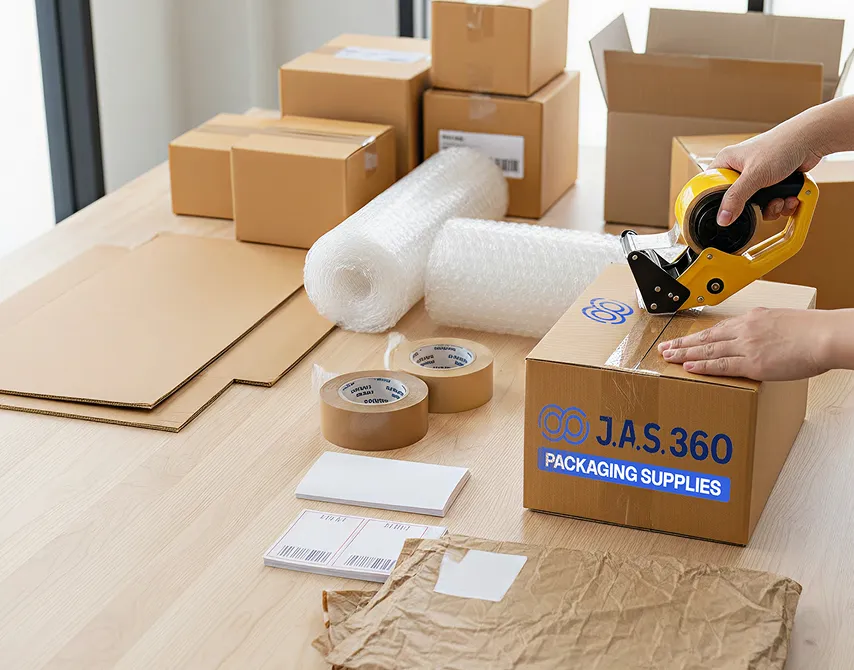
Roll materials are used across everything from warehouse packaging and technical printing to food presentation and specialist manufacturing. But choosing the right material isn't simply a matter of finding a roll in the right width.
The application, material properties, roll dimensions and how the product will be used all matter.
Three materials we regularly work with are kraft paper, bond paper and clear acetate/PVC film. While they may all arrive in roll form, their applications are very different.
When Does Kraft Paper Make Sense?
Kraft paper is one of those materials that appears in almost every part of industry.
Its strength is its simplicity.
It can be used to wrap products, separate layers, protect surfaces, fill empty space in packaging or cover work areas. For warehouses and manufacturers trying to reduce their use of plastic packaging, paper can also provide a practical alternative for many applications.
The important consideration isn't only the paper itself.
Roll width matters.
A roll that's significantly wider than the application can mean unnecessary material usage and awkward handling. A roll that's too narrow can slow down packing because operators need multiple sheets or passes.
Choosing a roll format that matches the application can therefore make a surprisingly large difference to day-to-day efficiency.
Bond Paper Is About the Printer
Bond paper has a completely different job.
Rather than protecting a product, it needs to move consistently through a wide-format printer or plotter and produce a reliable printed result.
Architects, engineers, construction businesses and other technical users commonly work with bond rolls for plans, drawings and documentation.
Here, compatibility becomes important.
Before ordering, it's worth checking:
- Required roll width
- Paper weight
- Core size
- Maximum roll diameter
- Printer specifications
Buying the cheapest roll isn't particularly useful if it doesn't suit the equipment it's going into.
Clear Film: Small Differences Can Matter
Clear acetate and PVC-type films are used where visibility and presentation are important.
A good example is cake collars.
The basic concept is simple — a clear strip forms a neat barrier around the edge of a cake or dessert. But the required film height can vary significantly depending on the finished product.
A bakery producing one product may need a 50 mm roll, while another application may require 60 mm or 100 mm.
This is where buying material only in large standard widths isn't always practical.
Why Custom Roll Widths Can Reduce Waste
Many industrial materials are originally manufactured as much wider reels.
Those reels can then be slit into narrower rolls suited to the final application.
For example, instead of repeatedly cutting material manually from an oversized roll, a business may be able to have the material converted into the width its operators actually use.
That can provide several operational benefits:
- Less material waste — the roll is better matched to the application.
- Faster handling — operators aren't constantly cutting oversized material.
- More consistent presentation — particularly important for packaging and food applications.
- Simpler inventory — businesses can stock a roll format designed around their process.
Standard Roll or Custom Converted Roll?
Standard rolls make sense when an off-the-shelf size already matches your requirements.
But if your team is regularly cutting rolls down, trimming material, throwing away excess width or struggling to find a particular size, it may be worth looking at a custom converted roll.
A useful starting point is to identify four things:
Material → Width → Length → Core
Once those are known, it's much easier to determine whether an existing product will work or whether converting a larger reel would provide a better solution.
The Advantage of Working With a Converting Business
Roll products can look deceptively simple.
But paper and film behave differently depending on the material, thickness, tension, width and final application.
J.A.S. has worked with roll materials and converting for more than 40 years. That experience means we look at the requirement from a converting perspective rather than simply asking, "What roll would you like to buy?"
Sometimes a standard product is the right answer.
Sometimes the better answer is to start with a larger reel and convert it into exactly what the customer needs.
Need Help Finding the Right Roll Format?
J.A.S. 360 supplies a range of industrial paper and film roll products, including kraft paper, bond paper and clear acetate/PVC rolls. If you can't find the width or format you need, talk to us about the application.
Tell us what you're trying to achieve — we'll help work out the roll that gets you there.